

Humanoid Sewing Robots: A Slippery Problem
Why humanoids can make your cappuccino but can't sew your clothes, yet
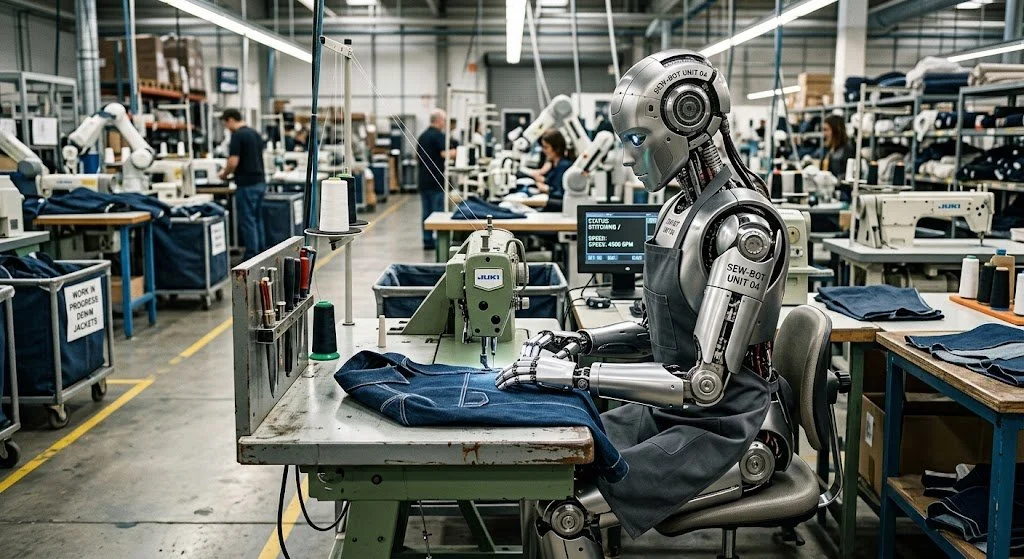
A concept render of an autonomous sew-bot assembling denim garments, AI-generated image
Humanoids in the past two years have increasingly been able to execute complex human-like movements. They can run faster than Usain Bolt, make coffee, decently fold laundry and can even get into fights. However, stitching more than a straight line is a struggle. The humanoid robotics industry could be worth over 38 billion dollars by 2035, according to Goldman Sachs. And still, manufacturing clothes is considered the hardest thing to automate.
Let’s do an experiment: hold a piece of fabric, consider its weight and texture, bring it close to your eyes and examine the structure to see if you can spot any pattern. Is it opaque? Is it sheer? Now flip it in the air to see how it falls back into your hands. Did it gracefully float down or just drop? Without any knowledge of fabrics, you’ve assessed its hand, you examined the weave, you assessed its cover and you figured out how it could drape around the body. You did it instinctively, without thinking about it, simply by touch, perception, feedback and natural hand adjustments.
“You've done more in five seconds than a humanoid sewing robot can do at all.”
In robotics this issue is called deformable object manipulation, the difficulty is that cloth has infinite degrees of freedom, its shape is always changing. It is one of the most complex bottlenecks in automating the garment industry end to end.
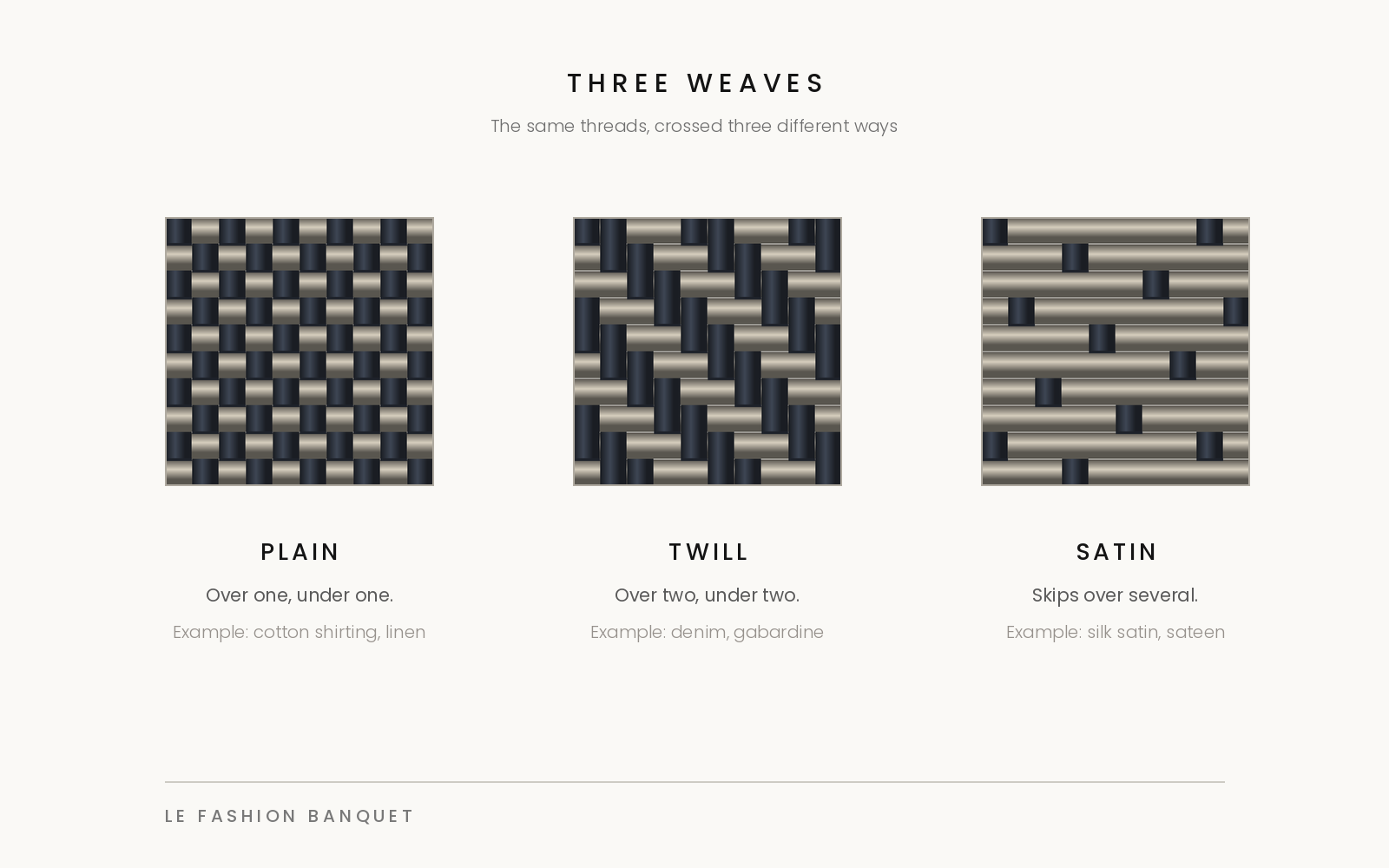
How plain, twill and satin weaves are constructed. Three different behaviours from one piece of cloth. This is part of the problem a robot has to solve
Pick up your piece of fabric again, flip it 45 degrees, and stretch it. It elongates on the diagonal, even if it has no stretch at all. Fabric has a grain, an axis that determines how it takes shape. If you change the direction you pull, the fabric behaves differently.
Now try a different fabric, perhaps what you are wearing. Stretch it one way, then another. Later, open your closet and repeat the experiment with silk, cotton, wool. Try leather, which stretches differently depending on where it sat on the animal. You’ve opened an infinite number of possibilities with variable outcomes and you knew exactly how much pressure to apply and how to adapt your grip.
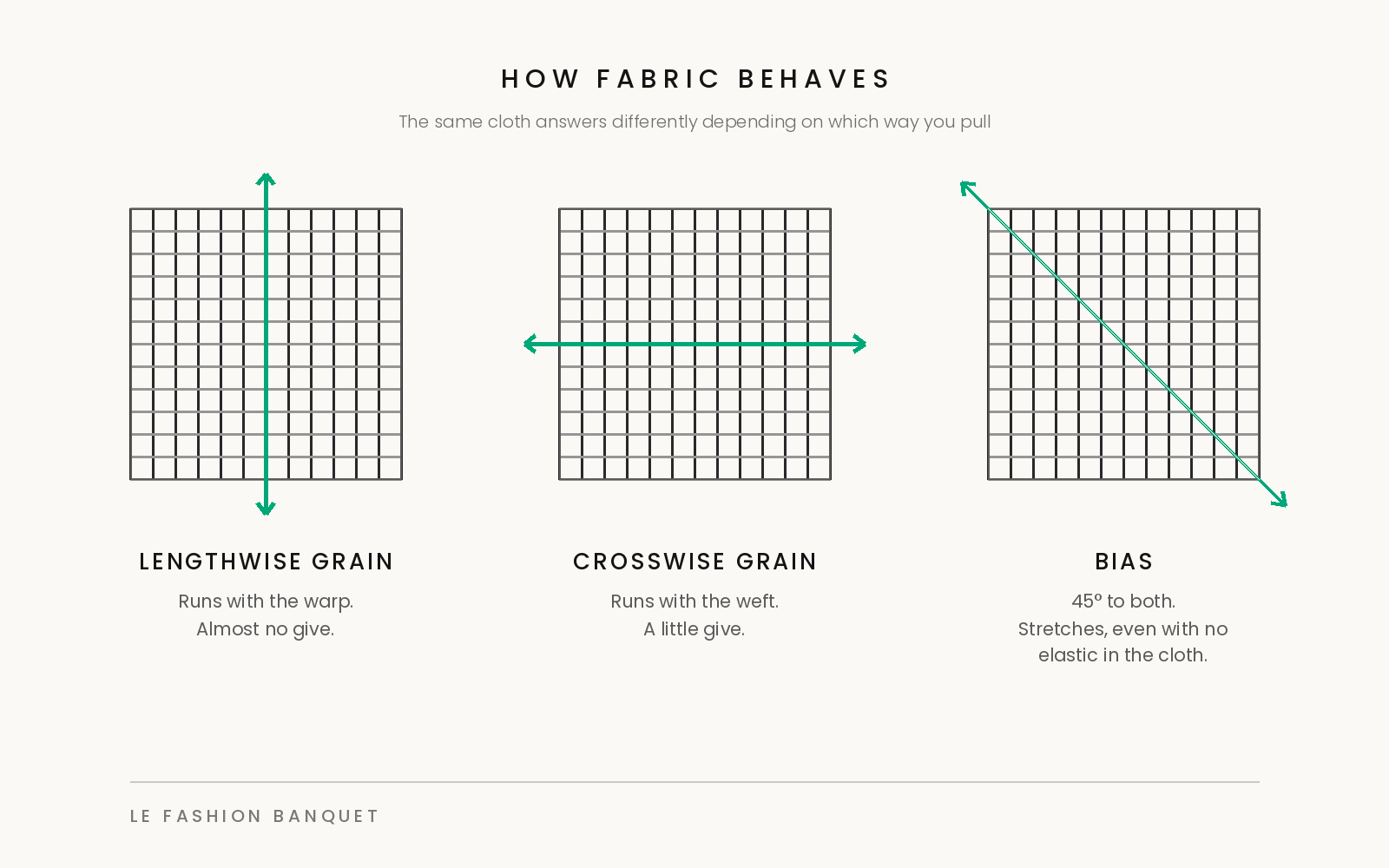
Pull a woven fabric straight up and down and it barely moves. Pull it side to side and it gives a little. Pull it on the diagonal and it stretches, even with no stretch in it at all
Handling a piece of cloth comes to us naturally with intuition and the sensations at our fingertips. A robot is not able to predict the different shapes a fabric takes when sewing. Sewbo, a Seattle-based startup, tackled this problem in 2016 by stiffening the fabric with a water-soluble solution, to temporarily eliminate the limpness of the garment. They turn cloth into a hardened material that robots can work with, then wash the stiffener off with water once the sewing is done.
Other companies have integrated AI and humanoid robotics to solve the problem. At the World AI Conference in Shanghai in July, Aitu showed its humanoid sewing on a lockstitch machine and changing templates between operations. SoftWear Automation in Atlanta has been at this since 2012. Its Sewbots can sew t-shirts, but their machines are built for a single garment made in a single fabric. Both use cases show the limits of what bots can accomplish even in very controlled, curated environments.
What about errors? In sewing, making mistakes is part of the process: test, stitch slowly, make a mistake, rip, and redo. For certain types of materials, like leather, or delicate material like silk, mistakes are unforgivable. I experienced it myself sewing my first leather bag. Any unwanted stitch in the material is permanent. Humanoid sewing robots not only need to pass each evaluation at a 100% rate each time, but must do so with no flakiness or regressions, or risk ruining materials. At the moment Aitu reports that in a factory setting, its robot can separate two pieces of fabric successfully 97% of the time, for one product category, with one type of fabric…
“To date, no fabric control strategy has successfully moved from the prototype stage to a tangible real-world application. ”
Pinching, pulling fabric there, easing the tension over here, backtracking, correcting: in truth the behavior of fabric in sewing cannot be reduced to rules. Large language models (ChatGPT, Claude, Gemini) learn in part by ingesting available data on the internet. Robots, on the other hand, need a massive amount of data showing the real world to analyze movements and build code used for training. It is why robotics companies are equipping factory workers with sensors to capture data, enabling the robots to build a statistical memory that can imitate human touch.
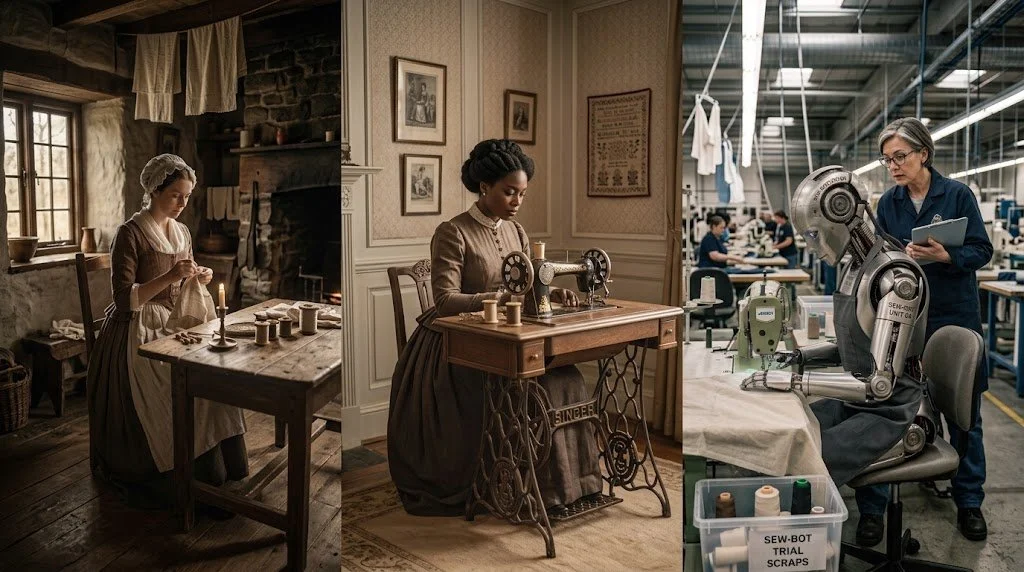
Three centuries of garment production: hand-sewing, early mechanization, and AI-driven sew-bots, AI-generated image.
Related reading: The Singer Sewing Machine and The Dakota in New York City: A Thread
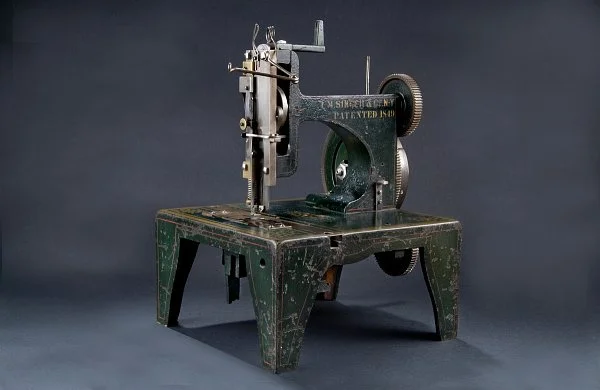
Sewing Machine Patent Model; Isaac Singer, 1855, National Museum of American History
This is not the first time a machine has been pointed at this problem. In the 1850s, Isaac Singer and the Singer sewing machine didn't eliminate seamstresses completely. It shifted the boundary of what humans and machines can do. That boundary has moved before and it will move again.
While the sewing machine was one of the first home appliances to enter American households, we are far from having humanoid robots sewing our t-shirts at home while we are sipping on our cappuccino. Hands and judgement remain the most adaptable tool we have. Craftspeople or garment workers will still need to rely on their own sensors to take the relay where the humanoid is just -oid.